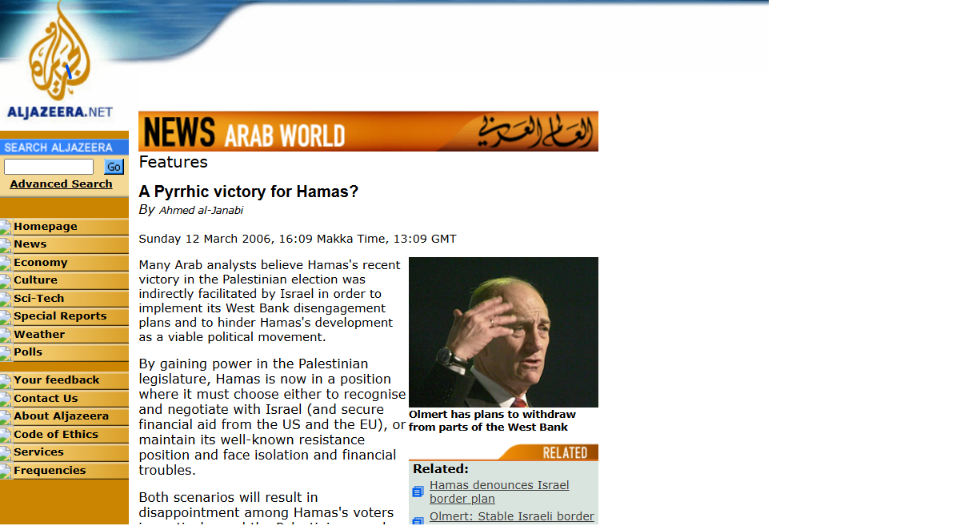
Please note: This article originally appeared with my byline on aljazeera.com. However, the byline may no longer be visible on their site. For verification, you can view a screenshot of the original published article at the end of this page.
Many Arab analysts believe Hamas’s recent victory in the Palestinian election was indirectly facilitated by Israel in order to implement its West Bank disengagement plans and to hinder Hamas’s development as a viable political movement.
By gaining power in the Palestinian legislature, Hamas is now in a position where it must choose either to recognise and negotiate with Israel (and secure financial aid from the US and the EU), or maintain its well-known resistance position and face isolation and financial troubles.
Both scenarios will result in disappointment among Hamas’s voters in particular and the Palestinian people in general.
Hasan Nafaa, a political science professor at Cairo University, Egypt, said the US and Israel knew that Fatah – the former movement in power – was fragmented, weakened by allegations of corruption, and unpopular with many Palestinians.
“Israel and the US knew Hamas was winning, they knew Fatah was weak and divided,” he said.
Muhammad al-Misfir, a Qatari political analyst and professor of political science at Qatar University, says that Hamas election victory should have surprised no one.
“I cannot see how the ordinary man in the street, especially in Palestine, knew Hamas was winning, while President Mahmoud Abbas says he was surprised,” he said.
“Israel and the US knew Hamas would win, but they also knew that the victory would put the group in a difficult position where no one would be willing to deal with the movement unless it recognises Israel.”
Unilateral disengagement
Regional analysts believe that Israel is using Hamas’s precarious position to its benefit and to pursue unilaterally a selective withdrawal from the West Bank where it would, in fact, expand large settlements.
Avi Dichter, one of the Israeli Kadima party candidates and former security service chief, said the party would immediately start working on a new “disengagement” if it won in the general elections on 28 March.
Ariel Sharon, the Israeli prime minister, who has been in a coma since suffering a stroke on 4 January, created Kadima in November with the express intention of fixing permanent borders for Israel – whether the Palestinians were on board or not.
Ehud Olmert, the acting prime minister, is presenting himself as Sharon’s heir, hoping to capitalise on public sympathy and admiration for him.
Assuming that Hamas will not be a proper peace partner, Olmert said he envisaged that the borders would include the West Bank settlement bloc of Gush Etzion, the “Ariel region” of settlements in the north, the “Jerusalem envelope”, Maale Adumim and the “Jordan River as a security border”.
Ahmed Qurei, the Palestinian prime minister, rejected unilateral disengagement plans as Israeli efforts to restrict any Palestinian state to Gaza.
Nafaa said: “Hamas is required to make concessions such as the recognition of Israel; a move that is against its ideology which gave the movement its popularity. In this case, Israel will go ahead with its unilateral disengagement and blame Hamas for failing to be a partner in the peace process.”
New tactics sought
Nafaa says Hamas must change tactics, think in strategic terms and weigh its options carefully.
He feared that regional governments would coerce Hamas into accepting a negotiating role with Israel.
“The problem now is all the Arab leaders will ask Hamas to sit with Israel and try to solve the problems,” he said.
“When the late Egyptian President Anwar al-Sadat went to Israel and then signed the Camp David agreement, he thought he was solving the conflict, but Israel signed the agreement to take Egypt out of the military balance of powers in the Middle East, and hence grab each Arab country individually to sign accords that are more of a surrender than peace agreements.”
Al-Misfir also believes that Hamas faces many obstacles in solving problems it inherited from its predecessor in power, Fatah.
“They are expected to take care of all the troubles at home and at the same time deal with Israel, the most demanding nation on earth. It is a very hectic mission,” he said.
US approach
But Harlan Ullman, a former adviser to the Pentagon, discounted notions that Israel “allowed” Hamas’s electoral victory.
“Neither Israel nor other states have the ability and access for producing such an outcome in Palestine or that matter in Iraq, Saudi Arabia or Egypt,” he said.
“Hamas was elected for many reasons; principally the ineffectiveness and often incompetence of Fatah, and its long record of humanitarian aid and assistance to the Palestinians.”
Martin Indyk, a former US ambassador to Israel, also ruled out an Israeli role in the Palestinian elections.
“There is plenty of evidence to show that the government of Israel tried its best to prevent Hamas from running in the elections and then tried to get the elections postponed,” he said.
“They were thwarted by a determined Bush administration that believes that elections equal democracy.
“The question for conspiracy theorists is why George Bush [the US president] pushed the elections so hard even when there were indications that Hamas would beat Fatah.”